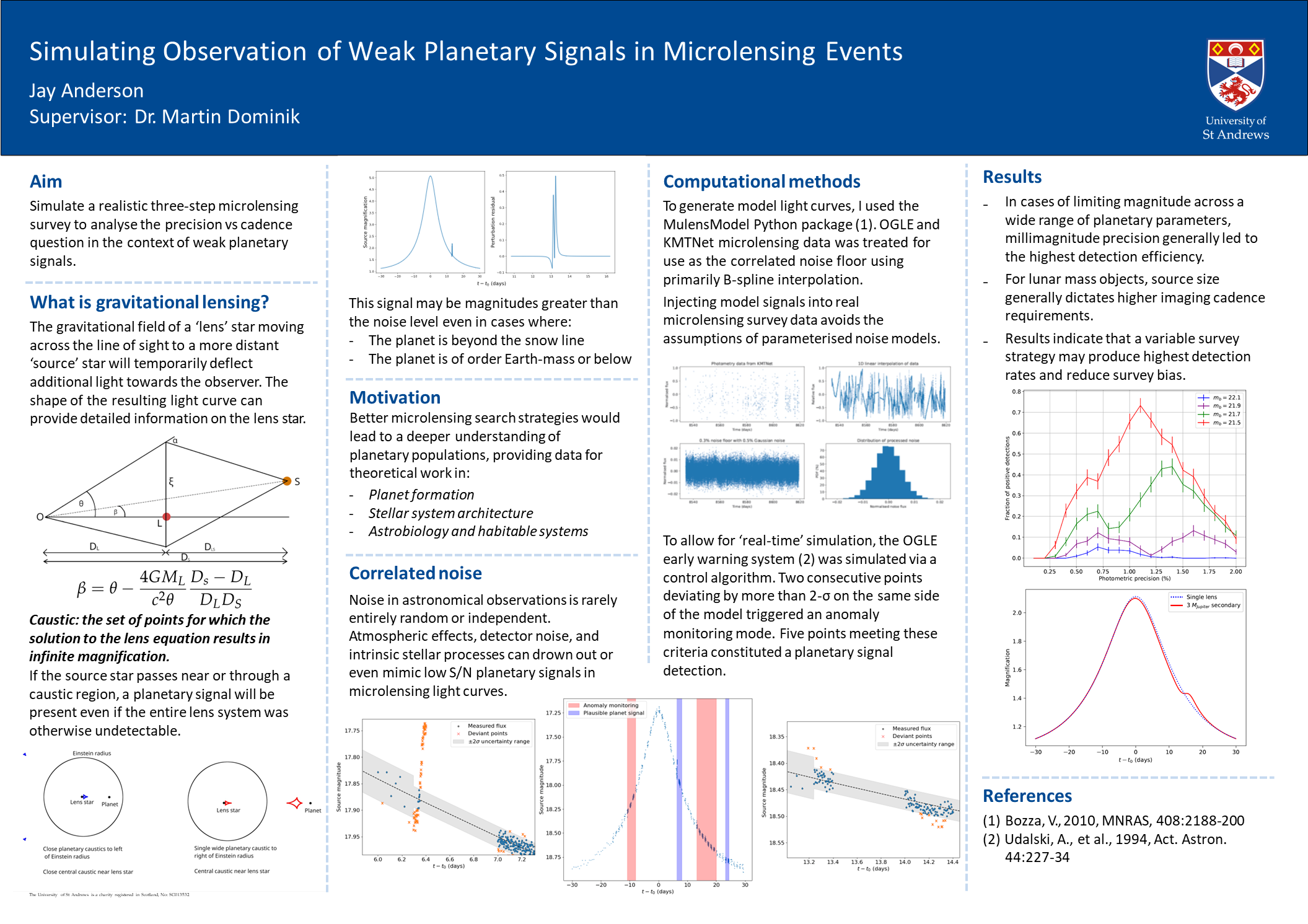
precision vs cadence:
Simulating Observation of Weak Planetary Signals in Microlensing Events
is the title of my 2024 MPhys dissertation.
Unfamiliar with the topic? Consider reading the [ gravitational microlensing primer ] before continuing.
When searching for exoplanets via gravitational microlensing events, the choice of imaging cadence is crucial. Planetary perturbations to PSPL light curves may only last a few hours, setting an upper limit to the range of cadences at which they can be detected. For this reason, many observations opt to prioritise a high cadence over photometric precision. However, debate continues as to whether this approach is the most effective for identifying planetary signals.
For my MPhys dissertation I have simulated a realistic three-step microlensing search survey, experimenting with various balances of precision vs cadence to identify an optimal search strategy. Model double-lens light curves generated by the Python MulensModel package are injected into real astronomical data, which is then systematically sampled to replicate the results of an exoplanet search.